
Running a business always involves some uncertainty. You may know how your company performed last month, how much it sold last year, or how many customers visited your website yesterday. But the bigger question is: what is likely to happen next?
Business forecasting is the process of using current and historical data, market trends, and other relevant information to estimate a company’s future performance. It helps businesses look ahead instead of making important decisions based only on what has already happened.
Forecasting can be used by a business to project future sales, consumer demand, expenses, cash needs, personnel needs, and other business consequences. Accurately predicting the future is not the aim. Rather, forecasting provides decision-makers with a better understanding of potential outcomes so they can make appropriate preparations.
Modern forecasting can involve everything from spreadsheets and statistical analysis to advanced predictive analytics, artificial intelligence, and machine learning. IBM notes that forecasting uses patterns and trends in previous and current data to make predictions about future events or conditions.
What Does Forecasting Mean in Business?
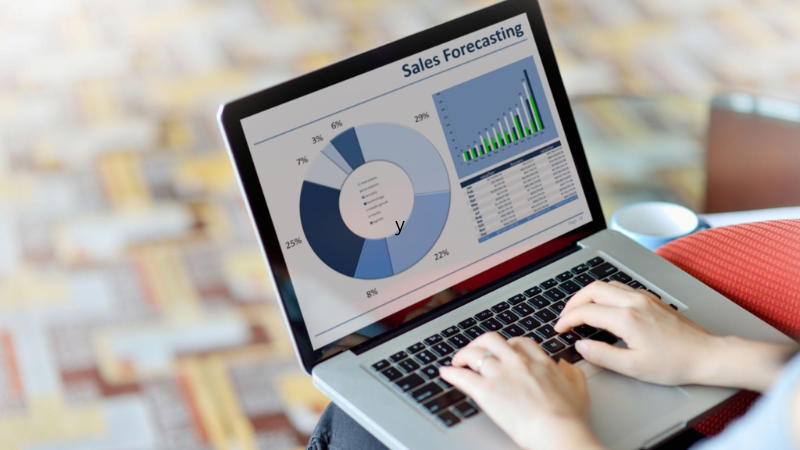
In simple terms, business forecasting means using what you know today to make a reasonable estimate about tomorrow.
Imagine a clothing retailer looking at its sales from the past three years. The business notices that demand for winter jackets rises every October and November. It can use that historical pattern, along with current sales, market conditions, and other information, to estimate how many jackets customers may purchase during the coming season.
That estimate can then influence how much inventory the company orders, how many employees it schedules, and how much money it sets aside for the season.
The same principle works across almost every part of a business.
A company might forecast:
- Future sales
- Customer demand
- Revenue
- Expenses
- Cash flow
- Inventory requirements
- Staffing needs
- Market growth
- Production requirements
- Working capital needs
The exact forecast depends on the question the business is trying to answer.
How Does Business Forecasting Work?
Business forecasting usually begins with a simple question: What do we need to predict?
Once the business identifies the goal, analysts collect relevant information and look for patterns that could help explain what may happen next.
Historical company data is often an important starting point. This could include previous sales, expenses, website traffic, customer behavior, inventory levels, or other performance measures.
However, looking only at historical numbers isn’t always enough. Current market conditions can change the picture. Economic conditions, customer preferences, competition, seasonal patterns, and other external factors can influence what happens next.
It has a typical forecasting process and therefore involves:
- Defining the forecasting objective
- Collecting relevant historical and current data
- Identifying trends and patterns
- Choosing an appropriate forecasting method
- Analyzing the information
- Creating a forecast
- Reviewing the forecast and adjusting it when necessary
Why Is Forecasting Important for a Business?
Businesses rarely have the luxury of knowing exactly what the future will look like.
A business may encounter an unforeseen shift in the market, a new competitor, increased operational expenses, supplier issues, or a sudden change in client demand. While forecasting can help organisations get ready for many scenarios, it does not completely eliminate those risks.
One of its biggest benefits is better decision-making.
For example, suppose a business expects customer demand to increase significantly over the next six months. Management may decide to increase inventory, hire additional workers, increase production, or adjust its marketing budget.
Without some form of forecast, those decisions would involve much more guesswork.
Forecasting can also help businesses determine how to allocate resources more effectively and prepare for changing market conditions.
What Are the Main Types of Business Forecasting?
Forecasting isn’t limited to one area of a company. Different departments can create forecasts based on the information they need.
Accounting Forecasting
Accounting forecasting uses historical cost and financial information to estimate future costs. Businesses can use these estimates when preparing budgets and planning future spending.
Business Forecasting
General business forecasting can cover a wide range of non-financial areas, including customer satisfaction, logistics, operational performance, and business goals.
The purpose is often to identify what may happen next and find ways to improve efficiency and profitability.
Capital Forecasting
Capital forecasting focuses on determining how much working capital a business may need in the future.
Businesses can examine factors such as sales, costs, assets, and liabilities to estimate their future capital requirements.
Demand Forecasting
Demand forecasting focuses on predicting how much customers are likely to want a particular product or service.
This is especially important for businesses that need to manage inventory and supply chains. If a company underestimates demand, it may run out of products. If it overestimates demand, it could end up holding more inventory than necessary.
Financial Forecasting
Financial forecasting looks at financial measures such as revenue, expenses, cash flow, and sales to estimate future financial performance.
These forecasts can support decisions involving budgets, investments, hiring, and business expansion.
Sales Forecasting
Sales forecasting estimates how many products or services a business is likely to sell during a particular future period.
Sales forecasts can cover weeks, months, quarters, or longer periods. They can then help guide inventory, staffing, budgeting, and sales planning.
What Data Is Used in Business Forecasting?
The quality of a forecast depends heavily on the information behind it.
Businesses can use many different types of data, depending on what they are trying to predict.
Some of the common examples are:
- Previous sales numbers
- Data on revenue and expenses
- Traffic to websites
- Rates of conversion
- Consumer conduct
- Stock levels
- Production information
- Trends in the market
- Seasonal trends
- Economic metrics
- Industry data
Quantitative vs. Qualitative Forecasting
Businesses can approach forecasting in different ways.
Quantitative forecasting relies heavily on numerical data, statistics, and mathematical models. Historical sales figures, trends, and other measurable information can be analyzed to estimate future results.
Qualitative forecasting, however, depends more on human judgement, experience, expert opinions, and industry knowledge. When there isn’t enough historical data available, such as when a business is introducing a brand-new product, this might be especially helpful.
In practice, businesses may combine both approaches rather than relying on only one.
Is Business Forecasting the Same as Predicting the Future?
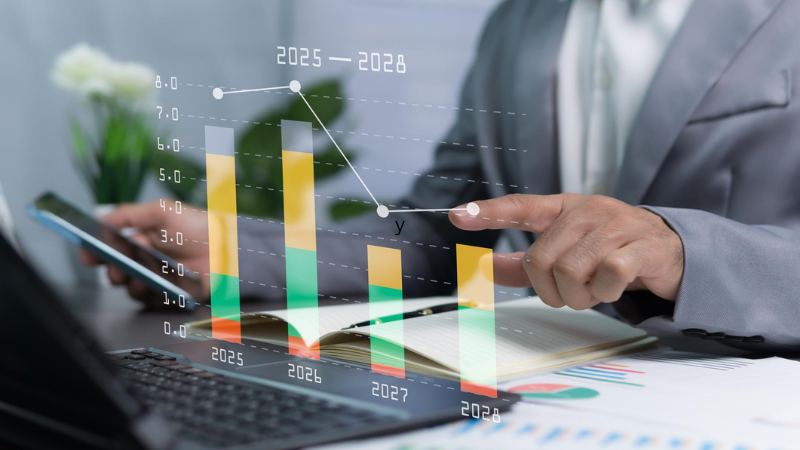
A forecast is an informed estimate, not a guarantee.
Even the most sophisticated forecasting model cannot account perfectly for every unexpected event. A sudden economic change, supply-chain disruption, new competitor, change in consumer behavior, or other unforeseen event can cause actual results to differ from projections.
IBM stresses that forecasts are guesses and should not be 100% correct. Another important factor is the time horizon; shorter-term projections are frequently more accurate than longer-term ones.
This is why businesses should use forecasts as decision-making tools rather than treating them as certain outcomes.
A Simple Example of Business Forecasting
Let’s say a small coffee shop wants to estimate how many cups of coffee it might sell next month.
The owner looks at sales from the previous 12 months and notices that sales tend to increase during colder months. The owner also checks current customer traffic, recent sales trends, local events, and planned promotions.
Based on this information, the business estimates that it will sell 12,000 cups next month.
That forecast could influence several decisions.
The owner may:
- Order more coffee beans and milk
- Schedule additional employees
- Increase the marketing budget
- Prepare for higher customer traffic
- Set a realistic revenue target
If actual sales later reach only 10,500 cups, the business can compare the result with the forecast and investigate why the difference occurred.
That comparison can make the next forecast better.
Why Forecast Accuracy Matters
A poor forecast can create problems in either direction.
If a company overestimates demand, it may purchase too much inventory, hire more staff than necessary, or spend money it doesn’t need to spend.
If it underestimates demand, the company may run out of products, miss sales opportunities, struggle with customer service, or fail to have enough employees available.
The aim isn’t necessarily to produce a perfect forecast. Instead, businesses want forecasts that are useful enough to support better decisions.
That is why forecasting is often an ongoing process rather than something a company completes once and forgets.
Business Forecasting in 2026
Forecasting has become increasingly data-driven.
Businesses now have access to larger volumes of information from sales systems, websites, customer platforms, financial software, supply chains, and other digital tools. At the same time, artificial intelligence and machine learning are being incorporated into forecasting systems.
AI forecasting can analyze historical patterns and continuously update models as new information becomes available.
This can make forecasting faster and more responsive, particularly for businesses dealing with rapidly changing markets.
However, technology doesn’t remove the need for human judgment.
A forecast still needs to be interpreted in the context of the business. Managers need to understand what the numbers mean, question unusual results, consider external circumstances, and decide what action makes sense.
What Is the Difference Between Forecasting and Budgeting?
Budgeting also looks toward the future, but it serves a different purpose.
A budget generally sets out what a business plans to spend and earn over a particular period.
A forecast estimates what is likely to happen based on current information and changing conditions.
Businesses can compare actual results with both their budgets and forecasts to understand where performance is different from expectations.
IBM describes forecasting as using historical data and current market conditions to estimate future revenue and other outcomes, while budgeting focuses on how a financial plan will be carried out.
Conclusion
Simply put, it is the process of using available information to make an informed estimate about what may happen in the future.
Whether a company is forecasting sales, customer demand, expenses, cash flow, inventory, or overall business performance, the basic purpose remains the same: look ahead and make better decisions today.
Forecasting cannot tell a business exactly what tomorrow will bring. But when it is based on useful data, sensible methods, and sound judgment, it can give business leaders a clearer view of the road ahead.
And in a business environment where customer behavior, markets, and technology can change quickly, having that forward-looking perspective can be a real advantage.
FAQ
What is forecasting in business?
The practice of estimating potential future events utilising historical data, current information, market trends, and analysis is known as business forecasting. Forecasts help businesses make better decisions about growth, cash flow, inventory, demand, staffing, sales, and expenses.
Why is business forecasting important?
Business forecasting helps companies prepare for what may be ahead instead of making every decision based on guesswork. A useful forecast can help a business allocate resources, plan budgets, estimate demand, manage costs, and respond to changing market conditions.
What is the main purpose of forecasting?
The main purpose of forecasting is to provide an informed estimate of future business conditions. It gives managers and decision-makers information they can use when planning operations, setting goals, managing resources, and making strategic decisions.
What is demand forecasting?
Demand forecasting estimates how much customers are likely to want a particular product or service in the future. It can help businesses decide how much inventory, production capacity, and other resources they may need.
What data is used for business forecasting?
Businesses can use many types of information, including historical sales, revenue, expenses, website traffic, conversion rates, customer behavior, inventory levels, market trends, and economic conditions. The exact data depends on what the company wants to forecast.
What is qualitative forecasting?
Qualitative forecasting relies more on human knowledge, experience, opinions, and expert judgment than on historical numerical data. It can be particularly useful when there isn’t enough historical information, such as when a business launches a new product.
Which is better: qualitative or quantitative forecasting?
Neither method is automatically better. The right approach depends on the business, available data, and purpose of the forecast. Many organizations combine numerical analysis with the experience and judgment of managers or industry experts.
Why do business forecasts fail?
Forecasts can miss the mark because of poor-quality data, unrealistic assumptions, sudden market changes, unexpected economic events, or using an unsuitable forecasting method. Another common problem is assuming that historical patterns will continue unchanged.
How often should a business update its forecast?
There isn’t one schedule that works for every company. Businesses operating in fast-changing markets may need to update forecasts frequently, while more stable businesses may review them monthly or quarterly. The important thing is to update the forecast when meaningful new information becomes available.
How does demand forecasting help inventory management?
Demand forecasting gives businesses an estimate of future customer demand. This can help them avoid ordering too much stock while also reducing the risk of running out of products when demand increases.
Can forecasting help with business growth?
Yes. A forecast can help a company estimate future demand and resources before expanding. For example, a business planning to enter a new market might forecast sales, expenses, staffing requirements, and capital needs before committing to the expansion.
Does business forecasting require advanced math?
Not always. Basic forecasting can be done with relatively simple calculations and spreadsheet tools. More advanced forecasting methods, such as regression analysis and statistical modeling, require stronger mathematical and analytical skills.
What skills are useful for business forecasting?
Important skills include statistical analysis, data interpretation, data visualization, critical thinking, strategic thinking, communication, and business knowledge. Technical skills such as Python or R can also be useful when working with larger datasets.