
New York has always been known for finance, media, fashion, and business. In recent years, though, the city has also become a major home for fast-growing technology companies.
The startup scene is particularly active in areas such as artificial intelligence, fintech, cybersecurity, enterprise software, and AI infrastructure. In June 2026 alone, 26 New York City startups announced Series A funding rounds, raising nearly $1.4 billion in Series A capital and more than $1.7 billion across all funding rounds.
That makes New York an interesting place to watch if you want to understand where new technology businesses are heading.
So, which startups deserve a closer look?
Rather than treating this as a fixed ranking, the following 10 companies stand out because of their recent funding, product growth, New York expansion, or position in fast-changing industries.
Which New York Startups Should You Watch?
| Startup | Main industry | What it does | Recent signal |
| Clay | AI / Sales | Helps sales and marketing teams find prospects and automate outreach | Expanded its NYC headquarters and announced plans for 498 new jobs |
| Cyera | Cybersecurity | Helps companies protect and manage sensitive data | Raised $600 million in a 2026 Series G at a $12 billion valuation |
| EliseAI | AI / PropTech | Automates workflows for housing and healthcare | Reported $200 million in annual recurring revenue in 2026 |
| ElevenLabs | AI / Voice | Builds AI voice and audio technology | Passed $500 million ARR in early 2026 and expanded its NYC operations |
| Fluidstack | AI Infrastructure | Builds specialised computing infrastructure for AI companies | Raised $830 million at a $7.5 billion valuation in 2026 |
| Hebbia | Enterprise AI | Helps professionals analyse large document collections | Maintains its headquarters in New York and continues developing AI for knowledge work |
| Kalshi | Fintech / Markets | Runs a prediction-market platform and financial products | Expanded into perpetual futures while facing regulatory litigation in New York |
| Ramp | Fintech | Provides corporate cards, expense management, and financial software | Raised $750 million at a $44 billion valuation in June 2026 |
| Rogo | AI / Finance | Builds AI tools for investment banking and financial services | Raised $160 million in Series D funding in 2026 |
| Runway | Generative AI | Develops AI video and world-model technology | Raised $315 million in Series E funding at a $5.3 billion valuation |
The order above is alphabetical by company name, not a ranking. Several of these businesses are already well beyond the earliest startup stage, but they remain private, fast-growing technology companies worth following.
Why Is Clay One of the New York Startups to Watch?
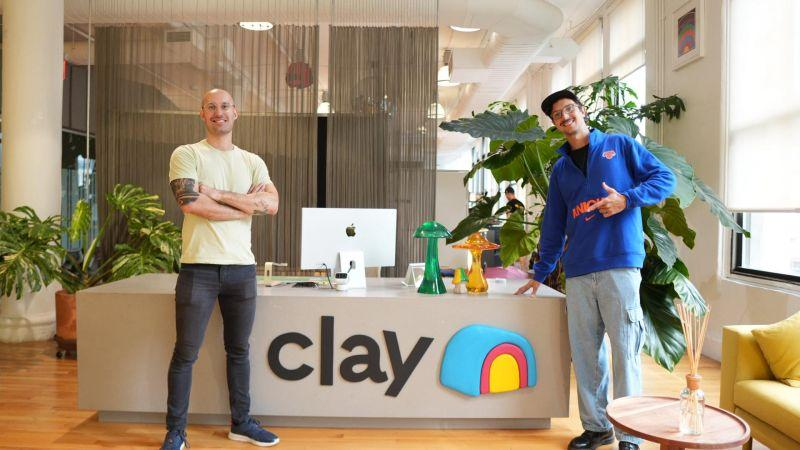
Clay sits at the intersection of artificial intelligence, sales, marketing, and data.
The company gives revenue teams access to large numbers of data sources and AI-powered tools that can help identify potential customers and personalise outreach. It was founded in New York in 2017 and has grown to more than 10,000 customers, according to New York State.
Particularly noteworthy is its spread into New York. Clay declared in 2026 that it will lease about 163,000 square feet at 11 Madison Avenue in Manhattan, invest $50 million in New York R&D, and create 498 new full-time jobs over a five-year period.
Why Is Cyera Getting Attention in Cybersecurity?
Cyera focuses on data security, an area becoming increasingly important as businesses use more cloud services and AI systems.
The company says its technology helps organisations understand what sensitive data they have, where it is located, and who can access it. In June 2026, Cyera announced a $600 million Series G round at a $12 billion valuation.
Its business is tied to a very practical problem: companies want to use AI and large amounts of data without losing control of sensitive information.
That makes data security an important part of the wider AI infrastructure conversation.
What Makes EliseAI Interesting?
EliseAI focuses on a less glamorous but very large problem: automating everyday work in housing and healthcare.
Its systems handle workflows such as leasing, resident communication, maintenance-related tasks, and other operational processes. In June 2026, EliseAI said it had passed $200 million in annual recurring revenue after five consecutive years of 100% year-over-year growth. Those figures are company-reported.
What makes the company particularly interesting is its focus on vertical AI.
Instead of building a general-purpose chatbot, EliseAI is designed around specific industries with complicated rules and workflows. That approach could become increasingly common as businesses look for AI that understands their particular operations.
Why Is ElevenLabs Important to New York’s AI Scene?
ElevenLabs is known for AI-generated speech, voice technology, and related audio tools.
The company reported that it had passed $500 million in annual recurring revenue during the first four months of 2026. It said the growth was being driven partly by businesses deploying voice agents for areas such as customer support, sales, hiring, and marketing.
New York is becoming an important part of the company’s expansion. New York State announced in January 2026 that ElevenLabs planned to expand its Manhattan operations, invest $33 million in R&D, and create 230 new jobs.
Voice AI is moving beyond entertainment and into everyday business communication, which gives ElevenLabs a broad market to develop.
Why Is Fluidstack Worth Watching?
Not every AI company is building an AI application. Some are building the infrastructure needed to run those applications.
Fluidstack is one of them.
The company develops computing infrastructure for AI labs and relocated its global headquarters to New York City in late 2025. It also announced plans connected with large-scale AI infrastructure projects in New York and other parts of the United States.
In July 2026, Fluidstack announced an $830 million Series A round at a $7.5 billion valuation.
As AI models require more computing power, companies supplying the underlying infrastructure have become an important part of the technology ecosystem.
What Does Hebbia Do?
Hebbia builds AI tools designed to help professionals work with large collections of documents and other unstructured information.
Its technology is particularly relevant to areas such as finance, legal work, research, and other knowledge-heavy industries where employees may spend hours searching through reports, filings, contracts, and other documents.
Hebbia is headquartered in New York and has raised more than $160 million according to company-tracking data.
The company represents a broader trend in enterprise AI: instead of simply asking a chatbot a question, professionals can use AI to work through complicated information and complete multi-step research tasks.
Why Is Kalshi Worth Following?
Kalshi operates a prediction-market platform and has been expanding its financial product offering.
In May 2026, the company announced the launch of perpetual futures contracts in the United States.
Regulatory issues have hindered Kalshi’s expansion. The attorney general of New York launched a lawsuit in July 2026, claiming that Kalshi was running an illicit gambling business in the state.
That combination of financial innovation and regulatory uncertainty makes Kalshi a company worth watching closely, especially for people interested in fintech and financial markets.
Why Has Ramp Become One of New York’s Biggest Fintech Stories?
Ramp provides corporate cards, expense management, and financial software for businesses.
The company has grown well beyond the typical early-stage startup. In June 2026, Ramp announced a $750 million funding round at a $44 billion valuation. TechCrunch reported that the company said its annualised revenue had passed $1 billion.
Ramp is interesting because it is trying to combine financial services with software and automation rather than offering a single financial product.
Its growth also highlights New York’s long-standing strength in fintech.
What Is Rogo Building for the Finance Industry?

Rogo develops AI software specifically for financial professionals.
Its platform is designed to help investment banks and other financial institutions with research, analysis, and other knowledge-heavy workflows. In April 2026, Rogo raised $160 million in Series D funding, bringing its total funding to more than $300 million, according to the company’s announcement.
The company also announced in September 2026 that several large financial institutions had invested strategically in the business, adding to a group of bank investors across multiple major financial centres.
That is particularly relevant in New York, where investment banking and financial services provide a large potential customer base for specialised AI software.
Why Is Runway One of New York’s Most Interesting AI Companies?
Runway started by building AI tools for video creation and has increasingly moved toward a broader vision involving world models.
In February 2026, the company announced a $315 million Series E funding round led by General Atlantic, with participation from investors including NVIDIA and Adobe Ventures. TechCrunch reported that the round valued Runway at approximately $5.3 billion.
The company was built in New York by founders who met at NYU’s Tisch School of the Arts.
Runway is particularly interesting because its ambitions now extend beyond video creation into AI systems intended to model and interact with the physical world.
What Can We Learn From These New York Startups?
Looking across these companies, one thing becomes clear: New York’s startup scene is much broader than one industry.
There are several major themes running through the current ecosystem.
Is AI Dominating New York’s Startup Scene?
AI is clearly one of the biggest themes.
Clay, Cyera, EliseAI, ElevenLabs, Fluidstack, Hebbia, Rogo, and Runway all use AI as a core part of their products or infrastructure.
Tech:NYC’s 2026 funding data also shows strong activity in AI and enterprise infrastructure, while finance and healthcare remain important areas for New York founders.
Is Fintech Still Important in New York?
Very much so.
Ramp and Kalshi illustrate two very different directions in financial technology: business financial infrastructure on one side and new types of market products on the other.
New York’s concentration of banks, financial institutions, investors, and business customers continues to give fintech founders a large local market.
Are New York Startups Building for Traditional Industries?
Yes.
EliseAI is working in housing and healthcare. Rogo focuses on finance. Cyera focuses on enterprise security. Hebbia serves knowledge-heavy professional work.
That suggests an important shift in startup building: many companies are taking advanced technology and applying it to industries that have existed for decades.
Are These New York Startups Already Successful?
Several have already reached substantial scale, which is worth remembering when using the word “startup.”
Ramp has a reported $44 billion valuation, Fluidstack announced a $7.5 billion valuation, Runway was reported at $5.3 billion after its 2026 Series E, and Clay announced a $7.1 billion valuation in September 2026.
So this list includes both emerging companies and private technology businesses that have grown into major venture-backed firms.
Conclusion
New York’s startup ecosystem is entering an interesting period. The city is producing companies across AI, fintech, cybersecurity, enterprise software, infrastructure, and specialised industry technology.
What stands out is not simply the amount of money being raised. It is the variety of problems these companies are trying to solve.
Some are building the infrastructure needed for AI. Others are applying AI to finance, housing, sales, legal work, cybersecurity, or creative industries. Meanwhile, fintech companies are continuing to rethink how businesses manage money and how new financial markets operate.
That makes New York a startup ecosystem worth following closely. The companies above offer a useful snapshot of where founders and investors are putting their energy in 2026, while the wider city continues to produce new businesses across a surprisingly broad range of industries.
FAQ
What Industries Are New York Startups Focusing On?
AI, fintech, cybersecurity, enterprise software, healthcare technology, sales technology, and AI infrastructure are among the major areas attracting startup activity in New York.
Why Is New York a Strong Startup Hub?
New York combines a large financial and business community with access to investors, customers, technology talent, and established industries. Recent funding activity also shows strong startup momentum across several sectors.
Which New York Startup Is Focused on AI Sales Tools?
Clay focuses on sales and marketing technology, helping businesses use data and AI to find prospects and personalise outreach. The company has also announced a major expansion of its New York headquarters.
What Does Cyera Do?
Cyera focuses on data security and helps businesses understand, manage, and protect sensitive information. The company announced a $600 million Series G funding round in 2026 at a reported $12 billion valuation.
Why Is ElevenLabs Growing So Quickly?
ElevenLabs develops AI voice and audio technology for applications such as voice agents, customer service, sales, and content creation. The company reported passing $500 million in annual recurring revenue in early 2026.
What Does Fluidstack Do?
Fluidstack builds computing infrastructure designed for AI companies and research organisations. It has expanded its New York presence and announced an $830 million Series A round in 2026.
What Does Hebbia Do?
Hebbia develops AI tools that help professionals work with large collections of documents and complex information. Its products are aimed at knowledge-heavy areas such as finance and research.
Why Is Ramp One of New York’s Biggest Fintech Startups?
Ramp provides corporate cards, expense management, and financial software for businesses. In June 2026, the company announced a $750 million funding round at a reported $44 billion valuation.
What Does Rogo Build?
Rogo develops AI software for financial professionals, helping with research and other finance-related workflows. The company raised $160 million in Series D funding in 2026.
What Is Runway Known For?
Runway is known for generative AI tools for video and creative work and is developing broader AI technology around world models. It raised $315 million in Series E funding in 2026 at a reported $5.3 billion valuation.
Are These New York Startups Still Considered Startups?
Some are now quite large by startup standards. Companies such as Ramp, Fluidstack, and Runway have reached multi-billion-dollar valuations, but they remain private, venture-backed technology companies.
Why Are So Many New York Startups Building AI Companies?
New York has a strong concentration of businesses in finance, healthcare, media, sales, and other industries that generate large amounts of data. That gives AI startups a large local market for specialised products and enterprise tools.
What Should Entrepreneurs Learn From New York Startups?
A common theme is the focus on solving specific business problems rather than simply building generic technology. Many successful New York startups are applying AI to established industries such as finance, housing, cybersecurity, sales, and creative work.