
Every successful business needs a clear answer to one basic question: How does this business create value and make money?
A business model explains how a company serves its customers, delivers its products or services, earns revenue, and manages the costs involved in running the business. It gives entrepreneurs and business leaders a practical way to understand how all the moving parts of a company fit together.
Just think of it as a simple blueprint for the business; there is no need to describe every internal process or management decision. Instead, you focus on the parts that matter most: who you serve, what you offer, how you reach customers, what you need to operate, and how the money flows.
In today’s competitive market, having a good product is no longer enough. Businesses also need a business model that can compete, adapt, and grow.
What Is a Business Model?
In simple terms, a business model is a description of how a company does business and makes money.
It explains the relationship between a company’s customers, products or services, operations, partners, resources, revenue, and costs.
For example, two businesses can operate in the same industry but use completely different business models.
One might sell products directly to customers through physical stores. Another might sell the same type of product online through a subscription service. They may compete in the same market, but the way they create and capture value is different.
This is why simply knowing what industry a company operates in does not tell the whole story.
A strong business model helps answer questions such as:
- Who are our customers?
- What problem are you solving?
- What Value are you providing?
- How will customers find and buy from us?
- How will we build relationships with them?
- What resources do we need?
- Which activities are essential?
- Who are our key partners?
- How will the business generate revenue?
- What will it cost to operate?
When these pieces work together, a business has a clearer path toward sustainable growth.
The 9 Building Blocks of a Business Model
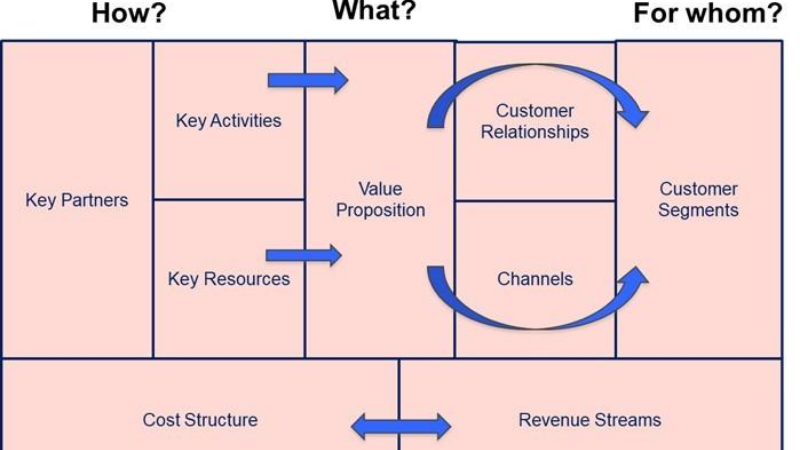
A useful way to understand a business model is through nine connected building blocks. Together, they provide a simple picture of how a company operates and makes money.
1. Value Proposition
The value proposition is the heart of the business model.
It explains what your business offers customers and why they should choose you.
Your value proposition could be a better product, lower price, greater convenience, faster delivery, better design, improved service, or a solution to a problem customers already have.
For example, a low-cost airline creates value by making air travel more affordable. An online marketplace creates value by making it easier for buyers and sellers to connect.
2. Customer Segments
A business cannot serve everyone equally well.
Customer segments identify the specific groups of people or organizations your business wants to serve.
These might include:
- Consumers
- Small businesses
- Large companies
- Students
- Professionals
- Families
- Specific industries
- High-income or price-sensitive customers
Understanding your customer makes everything else easier, from product development to marketing and pricing.
3. Channels
Channels describe how your business reaches customers and delivers its value proposition.
These can include:
- Physical stores
- Websites
- Mobile apps
- Social media
- Sales teams
- Online marketplaces
- Distributors
- Retail partners
A business might have an excellent product, but if customers cannot easily discover or purchase it, the business model will struggle.
Companies therefore need to think carefully about where their customers spend time and how they prefer to buy.
4. Customer Relationships
Customer relationships explain how a business interacts with its customers before, during, and after a purchase.
Some companies rely heavily on personal service. Others use automation, self-service platforms, communities, or subscription relationships.
For example, a business may build loyalty through:
- Personalized support
- Membership programs
- Its customer service
- Online communities
- Loyalty rewards
- Regular communication
5. Key Resources
Every business needs resources to deliver its value proposition.
These resources are:
- Employees
- Technology
- Equipment
- Buildings
- Intellectual property
- Data
- Capital
- Brand reputation
6. Key Activities
Key activities are the most important things a company must do to make its business model work.
Depending on the business, these could include:
- Manufacturing products
- Developing software
- Marketing
- Selling
- Delivering orders
- Managing a platform
- Providing professional services
- Supporting customers
A restaurant, for example, needs to purchase ingredients, prepare food, serve customers, manage staff, and maintain its premises.
A software company may spend more of its time developing products, maintaining infrastructure, acquiring customers, and providing technical support.
7. Key Partners
Businesses rarely operate completely on their own.
Key partners are the outside companies, suppliers, organizations, or individuals that help make the business model possible.
Partners may include:
- Suppliers
- Manufacturers
- Distributors
- Technology providers
- Logistics companies
- Retailers
- Strategic partners
Partnerships can help businesses access resources, reduce costs, reach new customers, or perform activities more efficiently.
A strong partner network can therefore become an important part of a company’s competitive advantage.
8. Revenue Streams
Revenue streams explain how the business actually makes money.
This is one of the most important parts of any business model.
Companies can generate revenue in many different ways, including:
- Direct product sales
- Service fees
- Subscriptions
- Advertising
- Licensing
- Commissions
- Memberships
- Transaction fees
Some companies rely on a single revenue stream, while others combine several.
For example, an online platform might earn money from advertising, subscriptions, and transaction fees at the same time.
9. Cost Structure
The final building block is the cost structure.
Every business has costs, and understanding them is essential for determining whether the business can be profitable.
Typical costs include:
- Employee salaries
- Rent
- Technology
- Marketing
- Manufacturing
- Inventory
- Transportation
- Utilities
- Professional services
A business model should not only explain how revenue is generated. It should also show what it takes to generate that revenue.
A company can have impressive sales and still struggle if its operating costs are too high.
Why Is a Business Model Important?
A business model gives entrepreneurs and managers a clearer view of how their company works.
Instead of looking at individual departments separately, it connects the major parts of the business.
For example, changing the customer segment can affect the value proposition. Changing the value proposition can require new resources or activities. Those changes can increase costs or create new revenue opportunities.
Everything is connected.
A well-designed business model can help a company:
- Understand its customers
- Identify profitable opportunities
- Control costs
- Find new revenue streams
- Improve customer relationships
- Respond to competitors
- Plan for growth
- Adapt to market changes
It can also reveal weaknesses before they become expensive problems.
Business Models and Innovation
Business models are closely connected to innovation.
Innovation is not limited to creating a completely new product. Sometimes the biggest opportunity comes from changing how a business creates, delivers, or captures value.
Consider the changes that have taken place across industries.
Distribution was revolutionised by the internet. Customers’ access to goods and leisure has been transformed by subscription services. Businesses now have new options to monetise internet audiences thanks to digital advertising. Who could afford to travel was altered by low-cost airlines.
These businesses did not necessarily invent an entirely new industry. They found new ways to operate within existing markets.
That is the power of business model innovation.
Innovation in the Value Proposition
A company can innovate by offering customers something different.
This could mean:
- Greater convenience
- Lower prices
- Better design
- Faster service
- More personalization
- A completely new type of experience
The objective is to create a reason for customers to choose the business.
Innovation in Customer Segments
Companies can also grow by finding customers who were previously underserved.
Low-cost airlines, for example, helped make air travel accessible to a much wider group of consumers by building their businesses around affordability.
Innovation in Distribution
The way products reach customers can completely change a business.
Online stores, mobile applications, marketplaces, and direct-to-consumer websites have allowed companies to reach customers without relying entirely on traditional physical distribution.
Innovation in Customer Relationships
Businesses, which can find new ways to maintain relationships with customers.
Subscriptions, memberships, loyalty programs, personalized recommendations, and digital communities can turn occasional buyers into long-term customers.
Innovation in Revenue
Sometimes the product stays relatively similar while the way the company earns money changes.
Advertising-supported services, subscription models, licensing, commissions, and pay-per-use pricing have all created new revenue opportunities across different industries.
Innovation in Costs
A company can also innovate by finding a more efficient way to operate.
Reducing unnecessary expenses, automating repetitive work, improving supply chains, or using technology more efficiently can make a business model more profitable.
Business Model vs. Business Strategy
Business models and business strategies are related, but they are not exactly the same.
A business model explains how the company creates, delivers, and captures value.
A business strategy explains how the company plans to compete and achieve its goals.
In simple terms:
Business model = How the business works and makes money.
Business strategy = How the business plans to win.
A company needs both.
A profitable business model can still fail if competitors execute a better strategy. Likewise, an excellent strategy will not help much if the underlying business model does not make financial sense.
How to Create a Business Model
You do not need a huge document to start designing your business model.
Begin with nine simple questions:
- What value do we offer?
- Who are our customers?
- How will we reach them?
- How will we build relationships with them?
- What resources do we need?
- What activities must we perform?
- Who can help us?
- How will we make money?
- What will it cost us?
Write down your answers and look at them as one connected system.
Then ask yourself whether the pieces actually fit together.
For example, if your target customers are highly price-sensitive but your business has expensive operations, you may have a problem. If customers expect fast delivery but your distribution system is slow, the value proposition may not match the actual customer experience.
This exercise can reveal problems before you spend significant amounts of money.
Examples of Business Model Innovation
Many well-known companies have succeeded partly because they found effective ways to organize their business models.
Dell demonstrated how the internet could be used as an important distribution and sales channel.
Gillette developed a recurring relationship with customers through its razor and replacement-blade model.
Google developed a powerful advertising-based revenue model around its search platform.
Apple has combined hardware, software, services, design, and an ecosystem to create multiple connected sources of value and revenue.
Walmart built a highly competitive model around scale, distribution, and cost efficiency.
These examples show that business model innovation can happen in many different parts of a company.
Why Businesses Need to Keep Adapting

Markets do not stay still.
Customer expectations change. Technology changes. Competitors copy successful ideas. New distribution channels appear. Costs rise, and new opportunities emerge.
A business model that works today may not work as well tomorrow.
That is why successful companies continually ask:
Can we serve customers better?
Can we deliver our value more efficiently?
Can we create another source of revenue?
Can we reduce unnecessary costs?
Is there a better way to operate?
This mindset helps businesses adapt instead of waiting until change forces them to react.
Conclusion
A business model is much more than a description of how a company earns money.
It is a practical picture of how the entire business fits together.
Every element plays an important part in the whole picture, including the clients you serve, the value you provide to the partners you depend on, the tasks you complete, the resources you require, the money you make, and the expenses you bear.
For entrepreneurs, a clear business model can turn an interesting idea into something that can actually be tested and built.
For established companies, it can provide a framework for finding new opportunities and responding to changing markets.
The businesses that understand their model are in a stronger position to improve it.
And in a market where successful ideas can quickly be copied, the ability to rethink and improve your business model may become one of your most valuable competitive advantages.
FAQ
What is a business model in simple terms?
A business model is the process by which an organization generates value for clients and earns revenue. It basically shows the company’s revenue, customers, products, etc.
Why is a business model important?
A business model helps you understand how the different parts of a company work together. It can help identify customers, revenue opportunities, major costs, important resources, and potential weaknesses before they become bigger problems.
What are the 9 building blocks of a business model?
The nine building blocks are value proposition, customer segments, channels, customer relationships, key resources, key activities, key partners, revenue streams, and cost structure. Together, they provide a simple overview of how a business operates.
What is a value proposition in a business model?
A value proposition explains why customers should choose your product or service. It could be based on price, convenience, quality, design, speed, personalization, or the ability to solve a particular customer problem.
What are customer segments?
Customer segments are the specific groups of people or organizations a business wants to serve. Defining these groups helps a company create products, marketing, pricing, and customer experiences that better match their needs.
What is the Business Model Canvas?
The Business Model Canvas is a practical framework for mapping out the key parts of a business model. It brings the nine building blocks together in one place, making it easier for entrepreneurs and managers to see how the business fits together.
What is business model innovation?
Business model innovation means finding a new or better way to create, deliver, or capture value. A company can innovate by changing its pricing, distribution, customer relationships, target market, revenue model, or even the way it performs key activities.
Why do companies need to change their business models?
Customer expectations, technology, competition, and operating costs are constantly changing. A business model that works well today may become less effective over time, so companies often need to adjust different parts of the model to remain competitive.
How do I create a business model for a new business?
Start by answering nine basic questions: What value will you provide? Who are your customers? How will you reach them? How will you build relationships? What resources and activities will you need? Who are your partners? How will you earn revenue? And what will it cost to operate?