
Starting a business is a good idea, but it’s not easy to start; there are a hundred things to figure out at once. What should you sell? Which business structure should you choose? Do you need an EIN? What licenses will you need? And, of course, how do you make sure everything is properly registered?
If you want to start a business in Minnesota in 2026, the process becomes much easier when you take it one step at a time.
Minnesota offers entrepreneurs a well-organized business environment, along with state resources that can help you understand registration, taxes, licenses, and other requirements. The key is to get the basics right before you spend too much money or start taking customers.
This guide walks you through the process in simple terms, from choosing your business idea to setting up your finances and staying compliant.
Why Start a Business in Minnesota in 2026?
Minnesota has a diverse economy, which gives entrepreneurs plenty of room to explore different types of businesses. Whether you want to open a local store, launch a professional service, build an online company, or create something more specialized, there are opportunities across different industries.
But a good business opportunity is more than simply having an idea.
You need to understand your customers, know what competitors are offering, estimate your startup costs, and work out how your business will actually make money.
Minnesota also has state agencies and resources designed to help new business owners understand the process. The Minnesota Department of Employment and Economic Development, for example, provides information and support for people planning to start and grow businesses.
That support can be particularly useful when you are still working out your business plan and deciding what you need before launch.
Minnesota’s Business-Friendly Environment

One of the biggest advantages for a new entrepreneur is having a clear process for getting the business paperwork in order.
The Minnesota Secretary of State provides business filing services, while the Minnesota Department of Revenue handles state tax registration and related requirements.
For businesses that need a Minnesota Tax ID, the Department of Revenue provides an online registration process. Depending on your business activities, you may also need to register for sales and use tax, withholding tax, or other state tax accounts.
The state also uses a business registration process that can reduce the amount of separate paperwork you have to deal with. For example, the Department of Revenue’s Form ABR can be used to register for applicable Minnesota tax types.
That does not mean starting a business is completely paperwork-free. It simply means you can approach the process in an organized way instead of trying to figure everything out at once.
What You Need Before Starting a Business in Minnesota
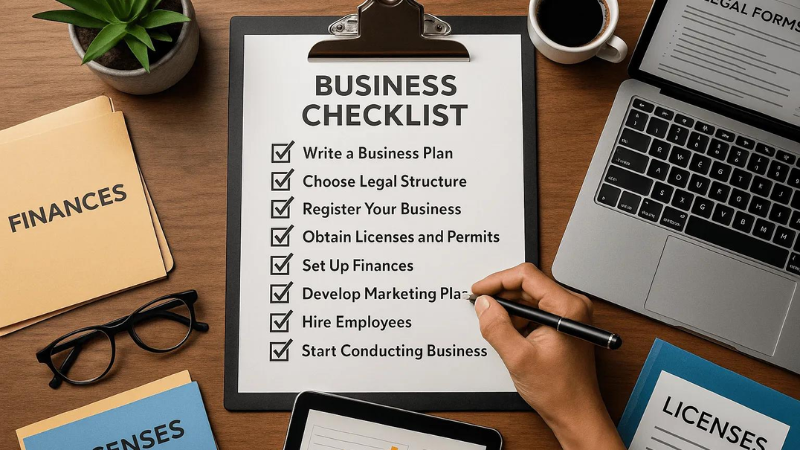
Before registering anything, take some time to prepare.
At a minimum, you should have:
- A clear business idea
- A basic business plan
- An estimate of startup costs
- A target customer
- A proposed business name
- A suitable legal structure
- Any required formation documents
- An EIN, if your business needs one
- Information about required licenses and permits
- A plan for managing business finances
Getting these details together early can save you from making expensive changes later.
Your business structure is particularly important because it can affect taxes, liability, paperwork, and how the business operates.
Step 1: Choose and Validate Your Business Idea
Every business starts with an idea, but not every idea becomes a successful business.
Before you spend money on equipment, advertising, inventory, or office space, ask yourself a few basic questions.
What exactly am I selling?
Your product or service should be easy to explain. If customers cannot quickly understand what you offer, it may be difficult to market.
Who is going to buy it?
Think beyond “everyone.” Identify the people most likely to need your product or service and understand what they care about.
Who are your competitors?
Look at businesses already serving the same customers. What are they doing well? Where are customers complaining? Is there something you can offer differently?
How much will it cost to get started?
Include obvious expenses such as equipment and inventory, but don’t forget insurance, software, marketing, professional services, rent, permits, and working capital.
What makes your business different?
You don’t necessarily need a completely new idea. Sometimes a better customer experience, more convenient service, specialized product, or stronger local focus is enough to create an advantage.
Doing this research before registration can help you avoid building a business around an idea that customers don’t actually want.
Step 2: Choose Your Business Structure
Choosing a legal structure is one of the most important decisions you’ll make.
Common options include:
- Sole proprietorship
- Limited Liability Company (LLC)
- Corporation
- Partnership
- Other specialized structures
A sole proprietorship is relatively simple, but it does not create the same legal separation between the owner and business that an LLC or corporation can provide.
An LLC is often attractive to small-business owners because it can provide liability protection while offering flexibility in how the business is managed and taxed.
Corporations can make sense for businesses with more complex ownership, investment, or growth plans.
There isn’t one structure that is best for everyone. Consider your risk level, number of owners, tax situation, plans for growth, and how much administrative work you’re prepared to handle.
If you’re unsure, speaking with an attorney or tax professional before filing can be money well spent.
Step 3: Choose and Register Your Business Name
It’s important to choose your business carefully, because it becomes your business identity.
Your business name should be:
- Easy to remember
- Relevant to what you do
- Simple to spell
- Distinct from competing businesses
- Suitable for your future growth
Step 4: Register Your Business With the State
After choosing your structure and name, you can move forward with formal registration.
For an LLC, this generally involves filing Articles of Organization. A corporation generally files Articles of Incorporation.
The Minnesota Secretary of State is responsible for business entity filings.
This is the step that turns your planned business structure into an officially recognized business entity under state law.
Don’t rush through the paperwork. Make sure names, addresses, ownership information, and other details are correct before submitting your filing.
A small mistake at this stage can create unnecessary work later.
Step 5: Get an Employer Identification Number (EIN)
An Employer Identification Number, commonly called an EIN, is a federal tax identification number issued by the IRS.
Depending on your business structure and circumstances, you may need one for purposes such as hiring employees, operating as a corporation, or handling certain federal tax filings.
If you need an EIN, apply through the IRS.
It’s useful to think of your EIN as one of the basic identification numbers associated with your business. Keep the documentation somewhere secure because you may need it when opening financial accounts, completing tax paperwork, or dealing with other business services.
Step 6: Register for Minnesota Taxes
Registering your business with the state does not automatically mean you’ve completed every tax requirement.
Your tax responsibilities depend on what your business does, how it is structured, whether you have employees, and which products or services you sell.
For example, Minnesota businesses may need a Minnesota Tax ID if they make taxable sales or leases, perform taxable services, withhold Minnesota income tax from employees, make certain estimated tax payments, or have other state tax obligations.
If you make taxable sales in Minnesota, you generally need to register for a Minnesota Tax ID and a Sales and Use Tax account before making those taxable sales.
The Minnesota Department of Revenue’s Form ABR can be used to register for applicable tax types, including sales and use tax and withholding tax.
This is one area where getting professional tax advice can be worthwhile, particularly if you’re hiring employees, selling across state lines, or operating a more complicated business.
Step 7: Check for Business Licenses and Permits
It’s important to have the proper licence to run your business; Minnesota businesses need the same licenses or permits.
The requirements can depend on:
- Your industry
- Your products or services
- Your business location
- Whether you have employees
- Local government rules
For example, a home-based consultant may have very different requirements from a restaurant, construction company, childcare provider, healthcare business, or retail store.
Step 8: Choose a Business Location
Your location can have a major impact on your costs and your ability to attract customers.
If you operate a physical business, consider:
- Rent and other occupancy costs
- Customer traffic
- Parking
- Accessibility
- Proximity to suppliers
- Local competition
- Employee access
- Zoning requirements
Zoning is especially important.
A property that looks perfect may not legally allow the type of business you want to operate there. Before signing a lease or purchasing property, check the applicable city or county zoning rules.
If you’re running an online or home-based business, don’t assume location rules don’t matter. Some local requirements can still apply depending on the nature of the business.
Step 9: Open a Business Bank Account
Once your business is established, separating business and personal finances should become a priority.
A dedicated business bank account makes it easier to:
- Track revenue
- Pay business expenses
- Organize records
- Prepare for tax filing
- Understand your cash flow
- Present a more professional image
When opening an account, banks may ask for business formation documents, an EIN, identification, and other information.
Choose an account based on your actual needs rather than simply choosing the first option you see.
Look at monthly fees, transaction limits, online banking features, payment processing options, and other services that matter to your business.
Step 10: Set Up Basic Accounting
There is no need for a complicated accounting system on day one, but you do need an organized one.
Track:
- Sales
- Business expenses
- Payroll
- Invoices
- Receipts
- Taxes
- Business assets
- Loans and other liabilities
Accounting software can make this much easier, especially as your business grows.
The most important habit is to keep accurate records from the beginning. Trying to reconstruct months of business transactions later can become a major headache.
Step 11: Find Your First Customers
Getting registered is not the same thing as getting customers.
This is where your marketing strategy starts to matter.
Begin with the channels that make sense for your target audience. Depending on your business, that could mean local networking, referrals, social media, search engines, email marketing, partnerships, online marketplaces, or direct outreach.
Don’t worry about trying every marketing channel at once.
Instead, choose a few that your customers actually use and learn what works.
Your first customers can also teach you a lot about your business. Pay attention to their questions, objections, feedback, and reasons for buying. That information can help you improve your product and marketing.
Minnesota Business Taxes and Compliance
Starting your business is only the beginning.
Once you’re operating, you’ll need to keep up with the tax and administrative responsibilities that apply to your business.
Minnesota’s Department of Revenue provides business tax registration and e-Services tools for businesses to manage applicable tax accounts, file returns, and make payments.
The state also continues to publish and update 2026 tax forms and instructions, so businesses should use current forms and guidance rather than relying on old paperwork.
Annual Reports and Ongoing Responsibilities
Forming your business is not a “set it and forget it” process.
You need to keep your business information current and complete any required annual or periodic filings.
You should also make sure that:
- Your registered information is accurate
- Your licenses remain valid
- Your tax accounts are properly maintained
- Your accounting records are organized
- Your business contracts are stored safely
- Your insurance remains appropriate
- Your company records are up to date
If you have employees, there will be additional payroll and employment responsibilities.
The more your business grows, the more important these systems become.
Common Mistakes New Minnesota Business Owners Should Avoid
Starting a business becomes much easier when you know which mistakes to avoid.
Choosing a structure too quickly
Don’t automatically choose an LLC simply because you’ve heard it’s the most popular option. Consider your circumstances and get professional advice when necessary.
Ignoring taxes until tax season
Taxes are an ongoing responsibility, not something to think about once a year.
Mixing personal and business money
This can make accounting and financial tracking unnecessarily difficult.
Signing a lease before checking zoning
A great location isn’t useful if your business isn’t permitted to operate there.
Spending too much before finding customers
A polished office and expensive branding won’t compensate for a lack of demand.
Forgetting licenses and permits
Business registration does not necessarily cover industry-specific requirements.
Failing to keep records
Good records make taxes, budgeting, financing, and everyday decision-making much easier.
Conclusion
Starting a business in Minnesota in 2026 can give you a lot of opportunities to develop and be successful. You will be prepared to get off to a great start if you know how to evaluate your business plan and manage permits and regulations appropriately. Minnesota is a great place to work and offers a wealth of resources to support you. Every action you take contributes to the realisation of your business goals. Thus, continue to learn, carefully consider every step you take, and relish the journey ahead. Do not hesitate to ask for extra assistance or guidance. Prepare for your business journey in Minnesota!
FAQ
Is Minnesota a good place to start a business?
Yes. Minnesota has a diverse economy and provides resources for entrepreneurs and new businesses. However, whether it is the right state for you depends on your industry, customers, startup budget, and business goals.
How much does it cost to register an LLC in Minnesota?
The filing cost depends on how you submit your LLC formation documents and the current state fee schedule. Before filing, check the latest Minnesota Secretary of State fee information so you are working with the current 2026 amount.
Do I need an EIN to start a business in Minnesota?
Not every business needs an EIN. Your requirements depend on your business structure and circumstances. An EIN is commonly needed when a business has employees or operates as certain types of entities. You can obtain one through the IRS when required.
How do I register for Minnesota business taxes?
Your tax responsibilities depend on your business activities. Businesses that have applicable Minnesota tax obligations may need to register with the Minnesota Department of Revenue. The state provides registration tools and Form ABR for applicable tax accounts.
Do I need a business plan to start a business in Minnesota?
A business plan is not simply paperwork; it is a useful roadmap. It can help you understand your customers, competitors, startup costs, pricing, marketing strategy, and expected revenue before you commit significant money to the business.
What should I do after registering my business in Minnesota?
Registration is only the beginning. After forming your business, check your EIN and tax requirements, obtain applicable licenses, open a business bank account, organize your accounting, arrange insurance, establish an online presence, and start working on customer acquisition.