
Human resources have always been about people, but a growing part of the work now involves technology.
From sorting job applications and scheduling interviews to managing payroll and helping employees find answers, artificial intelligence is becoming useful across many HR processes. Instead of handling every repetitive task manually, HR teams can use AI to save time and focus more on work that requires human judgment and communication.
AI’s function in HR goes beyond just using software to replace current procedures. It involves finding out how to effectively manage everyday tasks, comprehend employee data, encourage growth, and enhance the general employee experience.
So, how exactly is AI being used in human resources, and what should businesses know before adopting it?
How Is AI Being Used in HR?
AI can support almost every stage of the employee lifecycle.
HR teams can use AI during recruitment, onboarding, performance management, employee development, payroll, workforce planning, and employee support.
The table below gives a simple overview:
| HR Area | How AI Can Help |
| Recruitment | Screen applications, identify skills, schedule interviews |
| Onboarding | Create training materials and answer common questions |
| Performance management | Analyze performance data and provide insights |
| Employee development | Recommend learning paths and identify skill gaps |
| Payroll | Automate processing and help reduce errors |
| Workforce analytics | Analyze workforce trends and support planning |
| Employee support | Answer common HR questions and automate requests |
The biggest advantage is often time. When AI handles repetitive administrative work, HR professionals can spend more of their attention on people, strategy, and more complicated workplace issues.
How Can AI Improve Recruitment and Onboarding?

Recruitment can involve a lot of repetitive work.
HR teams may have to review large numbers of applications, coordinate interviews, communicate with candidates, and create job descriptions. AI can help automate some of these tasks and make the process more manageable.
For example, AI tools can help HR teams:
- Create interview questions and job descriptions.
- Find candidates who possess the necessary competencies
- Evaluate applicants according to their experience
- Use chatbots to interact with candidates
- Examine applicants and extend invitations to those who meet the requirements.
How Is AI Used in Performance Management?
Traditional performance reviews often require HR teams and managers to collect information from many different sources.
AI can analyze employee data and provide insights that may help managers understand performance more consistently. Instead of relying only on what happened shortly before an annual review, AI systems can work with information collected throughout the year.
This can support more regular feedback and help employees understand where they are doing well and where they may need improvement.
The source also notes that using information collected over time can help reduce issues such as recency bias, where the most recent events receive too much attention during an evaluation.
AI should still be used carefully here because performance decisions involve context that data alone may not capture.
How Can AI Support Employee Development?
Employees increasingly want opportunities to learn and grow, and AI can help HR teams make professional development more personalized.
Based on an employee’s present position and future objectives, AI may evaluate their skill set, spot any gaps, and suggest learning opportunities.
For example, instead of giving every employee the same training program, an AI-powered learning platform can recommend different content based on individual needs.
This can make development more relevant while also helping companies retain employees who are ready to take on new responsibilities.
How Does AI Help With Payroll and Financial Tracking?
Payroll is another area where repetitive manual work can create unnecessary pressure for HR teams.
AI can help automate payroll processing, reduce some common errors, consider relevant compliance requirements, and maintain clearer records of employee pay and changes.
AI can also analyze company spending and budgets.
What Types of AI Are Used in HR?
Different AI technologies can be useful for different HR tasks.
The source gives a few examples:
| AI Technology | Example HR Use |
| Generative AI | Creating job descriptions and performance reviews |
| Deep learning | Generating recommendations from employee or organizational data |
| Automation | Processing payroll and detecting possible fraud |
The important point is that businesses do not have to use the same type of AI for every HR problem. The technology should match the task.
What Are the Best AI Tools for HR?
There are now AI-powered tools covering many parts of the HR function. The source highlights examples across recruitment, employee development, performance management, workforce analytics, and HR operations.
Which AI Tools Help With Recruitment?
The source lists several recruitment and talent-acquisition platforms.
HireVue provides video interviewing and AI-supported candidate assessment.
Eightfold AI uses deep learning to match candidates with opportunities and support career development.
Pymetrics uses gamified assessments to evaluate certain cognitive and emotional traits.
Olivia by Paradox works as a conversational AI assistant for candidate screening, scheduling, and communication.
Phenom provides personalized career experiences, job matching, and recruiting tools.
These tools are designed to reduce repetitive recruitment work and help recruiters manage larger candidate pools.
Which AI Tools Help With Learning and Development?
AI can also support employee learning.
Degreed, EdCast, and Cornerstone OnDemand are highlighted in the source. These platforms may identify skill gaps, suggest educational materials, and design more individualized training programs.
This can be particularly useful for companies that want to make continuous learning part of their workplace culture.
Which AI Tools Help With Performance and Employee Engagement?
Performance management is another growing area for AI.
The source includes Lattice, Culture Amp, and 15Five.
These platforms can support goals, feedback, employee engagement surveys, check-ins, performance management, and manager development.
Rather than limiting employee feedback to one annual conversation, these tools can support a more continuous approach.
Which AI Tools Help With Workforce Planning?
Workforce analytics tools turn HR data into information that can support decisions about headcount, compensation, retention, and organizational effectiveness.
The source mentions Workday, SAP SuccessFactors, Visier, and Orgnostic as examples.
These platforms can be useful when HR teams need to understand patterns across a large workforce instead of reviewing everything manually.
Which AI Tools Help With Employee Support?
Some AI tools act as virtual HR assistants.
The source highlights Leena AI and ServiceNow HR Service Delivery as examples. These tools can answer common employee questions, automate HR requests, and route more complicated issues to the appropriate people.
For employees, the main benefit can be quicker access to basic information without having to wait for an HR team member to respond.
What Are the Benefits of AI in HR?
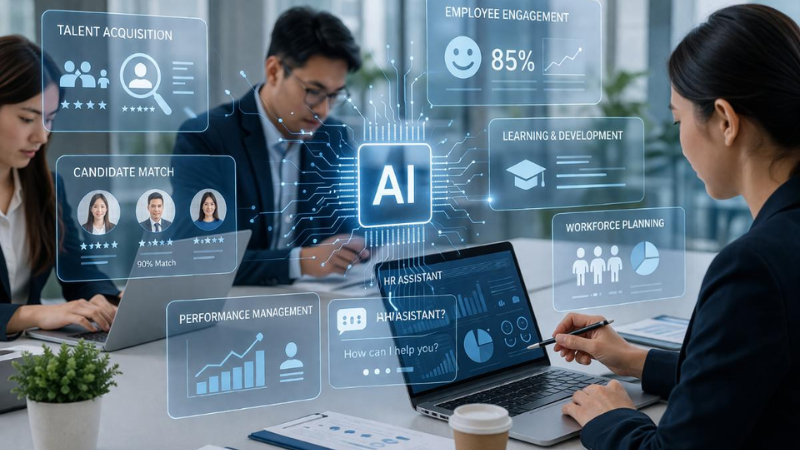
AI can affect HR in several practical ways.
Can AI Save HR Teams Time?
Yes. One of the most obvious benefits is reducing the amount of time spent on repetitive administrative tasks.
When AI handles routine work, HR professionals can spend more time on strategic projects, employee relationships, and organizational planning.
How Does AI Support Data-Driven Decisions?
HR departments generate a large amount of information through performance reviews, engagement surveys, compensation data, and employee turnover.
AI can analyze information from different sources and identify patterns that would take much longer to find manually.
This gives HR leaders more data to consider when making decisions.
Can AI Improve the Employee Experience?
AI-powered chatbots can answer common employee questions at different times of the day and across different time zones.
AI can also create more personalized learning recommendations based on an employee’s career goals and skill gaps.
That can make support and professional development feel more relevant.
Can AI Help HR Identify Problems Earlier?
By analyzing employee-related data continuously, AI can identify patterns that may point to issues such as turnover risk, skill gaps, burnout, or declining engagement.
This gives HR teams the opportunity to investigate a problem earlier rather than waiting until it becomes more serious.
Can AI Reduce Hiring Bias?
AI is sometimes presented as a way to make hiring more objective by focusing on data such as skills, experience, and performance.
However, the quality of that result depends heavily on how the system is designed and monitored. The source notes that AI can also reproduce existing biases in historical data, so human oversight remains important.
What Are the Risks of Using AI in HR?
AI can make HR processes more efficient, but it also introduces important concerns.
What Are the Data Privacy Risks?
HR systems often work with sensitive employee information.
AI applications may require large amounts of personal and workforce data, which creates privacy and security concerns. Businesses need appropriate safeguards to protect that information.
Employees may also have concerns about how much data is being collected and how it is being used.
Can AI Discriminate in Hiring?
Even when an AI system is designed to be objective, it may reproduce patterns found in historical data. If previous hiring decisions contained biases, an AI system trained on that data could potentially repeat them.
This is why ongoing auditing and human oversight are important when AI is used for decisions that affect employees.
Can Companies Become Too Dependent on AI?
AI systems can produce confident-sounding recommendations even when the underlying data is incomplete, or the assumptions are wrong. The source warns against relying too heavily on AI without questioning the quality of the data and the logic behind the recommendations.
HR professionals still need critical thinking and subject-matter expertise.
Why Does Data Quality Matter So Much?
AI depends on the information it receives.
Incomplete, outdated, or inaccurate HR data can lead to unreliable recommendations. Companies may also have data spread across different systems, making it harder to create a complete and consistent picture of the workforce.
In other words, better AI does not automatically fix bad data.
Will AI Replace HR Professionals?
The source argues that AI is unlikely to replace HR as a whole.
Instead, AI can take over some repetitive processes and give HR professionals more time for work that depends heavily on human judgment, communication, relationship-building, and emotional understanding.
For example, AI may help automate payroll or answer common employee questions, but resolving a difficult conflict between two employees still requires a human perspective.
This distinction is important. HR is not just an administrative function. Much of its value comes from understanding people and helping organizations work better.
How Should Businesses Start Using AI in HR?

The best place to start is with a real HR problem.
Instead of adopting AI simply because it is popular, identify a process that is repetitive, time-consuming, or difficult to manage manually.
Then consider:
- What task needs improvement?
- What employee or business data will the AI need?
- How sensitive is that information?
- Where should human review remain part of the process?
- How will you measure whether the technology is actually helping?
A focused approach makes it easier to test the technology, identify problems, and make improvements before expanding AI across the entire HR department.
What Does the Future of AI in HR Look Like?
AI is likely to become more closely connected with everyday HR operations.
Recruitment, employee learning, workforce analytics, payroll, performance management, and employee support are already areas where AI tools can assist teams.
But the future of HR is unlikely to be about choosing between people and technology.
The more practical approach is to combine both.
AI is well suited to handling large amounts of information and repetitive work. People remain important for judgment, empathy, communication, leadership, and decisions that require an understanding of individual circumstances.
Conclusion
AI in HR is transforming how many businesses manage routine human resources tasks.
It can help recruiters manage applications, support onboarding, personalize employee learning, automate payroll, analyze workforce data, and answer common HR questions.
At the same time, businesses need to be careful with privacy, bias, data quality, and over-reliance on automated recommendations.
The most useful role for AI may not be to replace HR professionals, but to take some of the repetitive work off their hands.
FAQ
How is AI used in HR?
AI can support recruitment, onboarding, performance management, employee development, payroll, workforce planning, and employee support.
What are the benefits of using AI in HR?
AI can save time, support data-driven decisions, improve the employee experience, identify potential problems earlier, and help HR teams handle larger workloads.
How does AI improve employee onboarding?
AI can create personalized training materials, automate the delivery of important information, and provide ongoing support through chatbots during the onboarding process.
What are the risks of using AI in HR?
Key concerns include data privacy, discrimination, limited emotional intelligence, over-reliance on technology, and poor data quality.
How can AI improve the employee experience?
AI-powered chatbots can provide quick answers to common questions, while AI learning tools can recommend training based on an employee’s goals, skills, and development needs.
What role does AI play in workforce analytics?
AI can analyze HR data to identify patterns related to headcount, compensation, retention, and organizational effectiveness.