
Running payroll may look simple when a business has only a few employees. You calculate wages, make the necessary deductions, send payments, and keep the records updated.
In reality, payroll can quickly become a time-consuming responsibility.
Small business owners have to deal with changing pay rates, employee hours, tax deductions, benefits, leave, payslips, deadlines, and payroll records. A small mistake can also create unnecessary stress for both the business and its employees.
This is where payroll services for small businesses can make a real difference. Instead of handling every payroll task manually, a business can use payroll software or outsource the work to a payroll provider.
The right option can save time, reduce repetitive work, and make it easier to keep payroll organised.
What Are Payroll Services for Small Businesses?
Payroll services are tools or professional services that help businesses manage employee payments and related payroll tasks.
Depending on the provider, payroll services may handle:
- Employee pay calculations
- Tax and payroll deductions
- Payslips
- Direct deposits or salary payments
- Payroll records
- Year-end payroll reporting
- Employee benefits
- Time and attendance information
- Payroll tax support
Some providers offer software that business owners operate themselves, while others manage most of the payroll process on behalf of the company.
Why Is Payroll So Important for a Small Business?
Employees expect to be paid correctly and on time. Payroll also affects a company’s financial records and its ability to meet relevant tax and employment obligations.
When payroll is handled poorly, even a small issue can become a bigger problem.
For example, submitting the incorrect amount of working hours may lead to an inaccurate payment. More administrative work may result from missing a deadline. Inadequate documentation can also make it more difficult to generate financial data or respond to enquiries from employees.
A reliable payroll process helps keep all of these details in order.
What Should a Small Business Payroll Service Include?
Not every payroll provider offers the same features, so it is worth comparing what is actually included in the service.
| Payroll feature | Why it matters |
| Salary and wage calculations | Helps ensure employees are paid correctly |
| Tax calculations | Reduces manual calculations |
| Payslips | Gives employees clear payment records |
| Direct deposit | Makes salary payments easier to manage |
| Time tracking | Connects hours worked with payroll |
| Leave management | Keeps employee leave information organised |
| Payroll reports | Helps with accounting and record-keeping |
| Employee self-service | Lets employees access their own payroll information |
| Compliance support | Helps businesses manage payroll-related requirements |
| Payroll integrations | Connects payroll with accounting and HR software |
The exact features depend on the provider and the package you choose.
Should You Use Payroll Software or Outsource Payroll?
This is one of the biggest decisions a small business owner needs to make.
With payroll software, you usually manage the process yourself using a payroll platform. This gives you more control and can work well when your payroll is relatively straightforward.
With outsourced payroll, an external provider handles more of the process for you. This can be useful when the owner does not have the time or experience to manage payroll internally.
| Option | Best suited for | Main advantage |
| DIY payroll | Very small teams | Lower hands-on service cost |
| Payroll software | Businesses comfortable with technology | More control and automation |
| Outsourced payroll | Owners who want less administration | Saves internal time |
| Accountant-managed payroll | Businesses already using an accountant | Payroll and accounting can work together |
There is no single solution that works for every small business.
How Much Do Payroll Services for Small Businesses Cost?
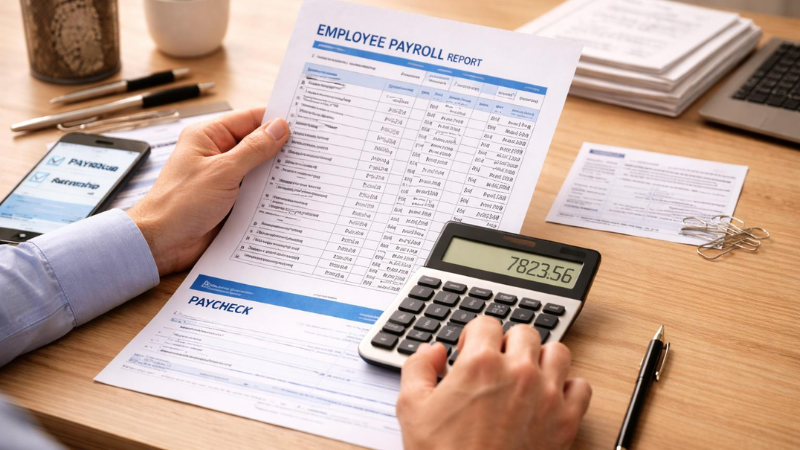
Payroll pricing depends on the provider, number of employees, features, and level of service.
Some payroll platforms charge a monthly base fee plus an amount per employee. Others may charge based on payroll runs, services used, or a customised package.
Before choosing a provider, look beyond the advertised starting price.
Check whether you will also pay for:
- Employee additions
- Tax filings
- Year-end reporting
- Payroll setup
- Direct deposit
- Additional payroll runs
- Benefits administration
- Support
- Integrations
A service that appears inexpensive at first can become more expensive once additional features are included.
How Can Payroll Services Save Small Businesses Time?
Payroll involves many small tasks that have to be repeated every pay period.
An automated payroll system can reduce the amount of manual work involved in collecting hours, calculating payments, preparing payslips, and producing reports.
For example, instead of calculating each employee’s pay from a spreadsheet, a payroll platform may pull approved hours from a time-tracking system and calculate the relevant amounts automatically.
That can free the business owner or office manager to focus on customers, sales, operations, and other priorities.
Can Payroll Services Help Reduce Payroll Errors?
They can reduce certain types of manual errors, particularly when payroll information is entered correctly and the system is configured properly.
Automated calculations can be useful for repetitive tasks such as:
- Adding regular wages
- Calculating overtime based on configured rules
- Tracking deductions
- Preparing payslips
- Maintaining payroll records
However, automation does not make a business completely error-proof. Someone still needs to review payroll information and make sure employee records, hours, pay rates, and other details are correct.
How Can Payroll Services Help With Compliance?
Payroll often involves rules that vary by location and can change over time.
A payroll provider may help with calculations, filings, records, and reminders, depending on the service package.
This can be especially useful for a small business that does not have an in-house payroll specialist.
However, businesses should understand exactly what their provider is responsible for. A contract may cover payroll processing without covering every tax, legal, or employment obligation.
What Payroll Challenges Do Small Businesses Commonly Face?
Small businesses often have fewer people available to handle administrative work, which means payroll responsibilities can end up with the owner or one employee.
Some of the Common challenges are:
- Entering employee information
- Tracking working hours
- Managing overtime
- Handling leave
- Keeping records updated
- Calculating deductions
- Meeting payroll deadlines
- Answering employee payroll questions
- Correcting mistakes
When Should a Small Business Consider Using a Payroll Service?
There is no specific employee count at which every business needs payroll software or outsourced payroll.
A Small business may want to consider a payroll service such as:
- The monthly payroll process takes too long.
- The number of employees is increasing
- Payroll errors are growing more frequent.
- Payroll is personally managed by the owner.
- The company employs people with varying schedules.
- Managing payroll requirements is getting more difficult.
- The business needs improved documentation and reporting.
What Should You Look for in a Payroll Service?
Price is important, but it should not be the only factor.
Look for a provider that is easy to use and fits the way your business operates.
Before signing up, consider:
Is the software easy to use?
You should be able to add employees, approve payroll, review reports, and correct basic information without constantly needing technical support.
Does it support employee self-service?
Employee portals can allow workers to view payslips, update certain details, or access payroll information without contacting the owner every time.
What kind of customer support is available?
Find out whether support is available by phone, email, chat, or another method, and check the hours of support.
Is the pricing transparent?
Ask for the full cost, including setup fees, employee charges, payroll runs, tax services, and optional features.
Can the service grow with your business?
The payroll system you choose should still make sense when your company has more employees and more complex payroll needs.
Can Payroll Services Work With Time Tracking?
Yes, many payroll systems can integrate with time and attendance tools.
This can be useful for businesses where employees are paid based on hours worked.
For example, an employee clocks in and out through a time-tracking system. The approved hours can then flow into payroll, reducing the need to enter the same information twice.
This is particularly useful for restaurants, retail businesses, cleaning companies, construction businesses, and other companies with hourly workers.
Can Payroll Services Manage Employee Benefits?
Some payroll platforms include benefits administration or integrate with separate benefits systems.
Depending on the provider, this may help businesses manage information related to benefits such as health plans, retirement contributions, or other employee programmes.
Because benefits rules differ by location and business, it is important to check exactly what a payroll provider supports before signing up.
Is Outsourcing Payroll Worth It for a Small Business?

Outsourcing can make sense when the cost of payroll administration is taking up too much of the owner’s or employee’s time.
Instead of spending hours processing payroll, the business can pay a specialist to handle much of the administrative work.
The trade-off is that outsourcing usually gives the business less direct control over the day-to-day process.
For a small company with a simple payroll, software may be enough. For a business with more complicated requirements, outsourced payroll can provide additional support.
How Can a Small Business Switch to a New Payroll Service?
Changing payroll systems does not have to be complicated, but it should be planned carefully.
A typical transition may involve:
- Choosing the new payroll provider.
- Gathering employee and payroll records.
- Setting up the company and employee information.
- Connecting accounting and time-tracking systems.
- Reviewing payroll settings.
- Testing the system before the first live payroll.
- Confirming that employee payments and records are accurate.
Avoid changing systems in the middle of a complicated payroll period unless there is a good reason to do so.
What Mistakes Should You Avoid When Choosing Payroll Services?
One common mistake is choosing a provider simply because it has the lowest advertised price.
A cheaper system may not include the features you actually need.
It is also a mistake to assume that “automated” means “no supervision required.” Payroll still needs regular review.
Before choosing a service, make sure you understand the:
- What the provider handles
- What you are responsible for
- What the service costs
- What integrations are available
- How employee data is protected
- How support works
- How difficult it is to change providers later
How Can Payroll Services Help a Growing Business?
As a company grows, payroll usually becomes more complicated.
You may have more employees, different pay rates, multiple locations, new benefits, contractors, or additional reporting requirements.
A payroll system can provide a more structured process as the business expands.
Instead of rebuilding your payroll process every time the company grows, you can use software and systems that are designed to handle additional employees and information.
Conclusion
Payroll may not be the most exciting part of running a business, but getting it right matters.
The right payroll service can take repetitive administrative work off your plate, make payroll easier to manage, and give your employees a more reliable payment experience.
Small businesses can choose between handling payroll themselves, using payroll software, or outsourcing the work to a professional provider.
Before choosing a provider, compare the full cost, features, integrations, support, and responsibilities involved. A payroll service should make your business easier to run, not create another complicated system to manage.
FAQ
What Are Payroll Services for Small Businesses?
Payroll services help small businesses manage employee payments and related tasks such as wage calculations, deductions, payslips, payroll records, and reporting.
Why Should a Small Business Use a Payroll Service?
A payroll service can reduce repetitive administrative work and make it easier to process employee payments accurately and on time. It can also give business owners more time to focus on daily operations.
Is Payroll Software Better Than Outsourcing Payroll?
It depends on the business. Payroll software gives owners more control, while outsourcing can reduce the amount of payroll work handled internally.
Can Payroll Services Reduce Payroll Errors?
They can reduce some manual calculation and data-entry errors, particularly when payroll information is entered correctly. Regular review is still important because automation does not eliminate every possible mistake.
Can Payroll Services Help With Payroll Compliance?
Many providers offer tools or services that support payroll-related filings, calculations, records, and deadlines. Businesses should check exactly which compliance responsibilities are included in the service.
When Should a Small Business Start Using Payroll Software?
It may be useful when payroll becomes time-consuming, the company is hiring more employees, mistakes are increasing, or the owner is spending too much time on payroll administration.
Can Payroll Services Handle Time Tracking?
Many payroll platforms can connect with time and attendance systems. This can help transfer approved working hours into payroll without requiring the information to be entered twice.
Can Payroll Services Manage Employee Benefits?
Some providers offer benefits administration or integrations with benefits platforms. The available options depend on the payroll service and the benefits offered by the business.
What Should I Look for in a Payroll Service?
Look at pricing, ease of use, payroll features, accounting integrations, employee self-service, customer support, data protection, and whether the system can grow with your business.
Are Payroll Services Suitable for Very Small Businesses?
Yes. Even businesses with only a few employees can benefit from payroll software or professional payroll support when handling payroll manually starts taking too much time.
Can Payroll Services Integrate With Accounting Software?
Many payroll platforms offer accounting integrations. This can reduce duplicate data entry and make it easier to keep payroll and financial records connected.
Can Payroll Services Help a Business Grow?
Yes. A good payroll system can provide a more organised process as the number of employees, pay structures, benefits, and reporting requirements increase.